Arrays are used to store multiple values in a single variable.
Each value is called an element, and each element has a numeric position in the array, known as its index.
Arrays are zero-indexed, meaning the first element is at index 0, the second at index 1, and so on.
Arrays can contain any data type, including numbers, strings, and objects.
const arr1 = [2, 4, 6]; array
arr1[0]; element at index 0 → 2
arr1[1]; element at index 1 → 4
arr1[2]; element at index 2 → 6
arr1[3]; element at index 3 → undefined index not found
Strings are a sequence of zero or more characters written inside quotes used to represent text.
Strings may consist of letters, numbers, symbols, words, or sentences.
Strings are immutable, they cannot be changed.
Each character in a string has an index.
The first character will be index 0 the second character will be index 1 and so on.
There are two ways to access an individual character in a string.
charAt() method
const str1 = "abc"; string
str1.charAt(0); character at index 0 → "a"
str1.charAt(1); character at index 1 → "b"
str1.charAt(2); character at index 2 → "c"
str1.charAt(3); character at index 3 → "" index not found
Alternatively use at() or slice() methods
bracket notation []
const str2 = "abc"; string
str2[0]; character at index 0 → "a"
str2[1]; character at index 1 → "b"
str2[2]; character at index 2 → "c"
str2[3]; character at index 3 → undefined index not found
Numbers are used to represent both integer and floating-point values.
Numbers are most commonly expressed in literal forms like 255 or 3.14159 ↴
let num1 = 5; → number
let num2 = 2.5; → number
let num3 = num1 + num2;
console.log(num3); returns ↴
7.5 → number
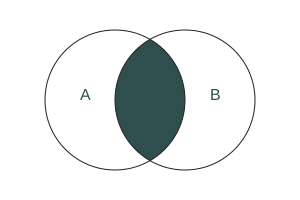
Find the intersection of two arrays using ↴
forEach() method → call a function for each element in an array, executing a provided function once for each array element.
includes() method → returns true if an array contains a specified value, otherwise returns false.
push() method → adds specified elements to the end of an array and returns the new length of the array.
forEach() method calls a function for each element in an array, executing a provided function once for each array element.
The method does not return a new array, it always returns undefined
const arr2 = [2, 4, 6, 8];
arr2.forEach((element, index, array) => {
array[index] = element * 2;
});
console.log(arr2); returns ↴
[4, 8, 12, 16] → value of each element is doubled
const arr3 = [2, 4, 6, 8];
arr3.forEach((element, index) => {
console.log(index, element)
}); returns ↴
0 2
1 4
2 6
3 8 → index and element printed to console
Use forEach() when an action is needed to be performed on each element,
not when a new array needs to be generated from the current one.
includes() method determines whether an array includes a certain value among its entries, returning true or false
const arr4 = [1, 2, 3, 4, 5, 6];
arr4.includes(4); returns boolean ↴
true → 4 found in array
const arr5 = [1, 2, 3, 4, 5, 6];
arr5.includes(7); returns boolean ↴
false → 7 NOT found in array
logical NOT ! syntax converts a true value to a false and vice-versa.
!arr4.includes(7); returns boolean ↴
true → 7 NOT found in array
push() method adds new elements to the end of an array.
Add 4 to end of array.
const arr6 = [1, 2, 3];
arr6.push(4);
console.log(arr6); returns ↴
[1, 2, 3, 4] → 4 added to end of array
The push() method changes the length of the array.
arr6 is modified.
Using the spread operator creates a new array.
Add 4 to a new array.
const arr7 = [1, 2 , 3];
const arr8 = [...arr7, 4];
console.log(arr8); returns ↴
[1, 2, 3, 4] → 4 added to new array
console.log(arr7); returns ↴
[1, 2 ,3]
arr7 remains unchanged.
Initialize the two input arrays to find their intersection.
first array ↴
const array1 = [1, 2, 3, 4]; → user input
second array ↴
const array2 = [3, 4, 5, 6]; → user input
Define a function findIntersection() to find the intersection of two arrays.
function findIntersection(arr1, arr2) {}
The function takes two arrays as input arr1, arr2 and returns a new array with their intersection. The original arrays remain unchanged.
Each input array may contain duplicates. Duplicates will be removed inside the function.
Initialize an array to hold the intersection.
intersection = [] intersection
forEach() method loops through the first array arr1, executing a callback function once for each array element.
arr1.forEach(callbackFn) ↴
callback function has 2 conditions ↴
(element) => arr2.includes(element) &&
!intersection.includes(element)
arr2.includes(element)
includes() method checks whether the current element is among the entries of the second array, arr2
If it is found, the element will be included in the intersection array if the next condition is also true.
!intersection.includes(element)
includes() method checks whether the intersection array does NOT already include the current element.
This eliminates any duplicates.
If BOTH condtions are true, the element is added to the intersection array.
intersection.push(element)
The function returns a new array containing only the unique elements that are common in both arrays.
return intersection
If there is no intersection present then an empty array [] is returned.
Initialize an empty array to hold the intersection.
const intersection = [];
Iterate over each element in the first array.
arr1.forEach(element => {})
Check if the element is present in the second array AND NOT already included in the intersection array.
if (arr2.includes(element) && !intersection.includes(element)) {}
If both conditions true, add the element to the intersection array.
intersection.push(element);
Return the array containing the intersection.
return intersection;
Call the function with ↴
findIntersection(array1, array2);
Find the intersection of two arrays.
const array1 = [1, 2, 3, 4];
const array2 = [3, 4, 5, 6];
function findIntersection(arr1, arr2) {
const intersection = [];
arr1.forEach(element => {
if (arr2.includes(element) && !intersection.includes(element)) {
intersection.push(element);
}
});
return intersection;
}
call function
findIntersection(array1, array2); returns ↴
[3, 4]
Alternative ↴
Instead of includes() use indexOf() method.
if (arr2.includes(element) && !intersection.includes(element)) {} ↴
if (arr2.indexOf(element) !== -1 && !intersection.includes(element)) {}