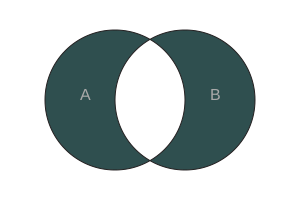
Arrays are used to store multiple values in a single variable.
Each value is called an element, and each element has a numeric position in the array, known as its index.
Arrays are zero-indexed, meaning the first element is at index 0, the second at index 1, and so on.
Arrays can contain any data type, including numbers, strings, and objects.
const arr1 = [2, 4, 6]; array
arr1[0]; element at index 0 → 2
arr1[1]; element at index 1 → 4
arr1[2]; element at index 2 → 6
arr1[3]; element at index 3 → undefined index not found
Strings are a sequence of zero or more characters written inside quotes used to represent text.
Strings may consist of letters, numbers, symbols, words, or sentences.
Strings are immutable, they cannot be changed.
Each character in a string has an index.
The first character will be index 0 the second character will be index 1 and so on.
There are two ways to access an individual character in a string.
charAt() method
const str1 = "abc"; string
str1.charAt(0); character at index 0 → "a"
str1.charAt(1); character at index 1 → "b"
str1.charAt(2); character at index 2 → "c"
str1.charAt(3); character at index 3 → "" index not found
Alternatively use at() or slice() methods
bracket notation []
const str2 = "abc"; string
str2[0]; character at index 0 → "a"
str2[1]; character at index 1 → "b"
str2[2]; character at index 2 → "c"
str2[3]; character at index 3 → undefined index not found
Numbers are used to represent both integer and floating-point values.
Numbers are most commonly expressed in literal forms like 255 or 3.14159 ↴
let num1 = 5; → number
let num2 = 2.5; → number
let num3 = num1 + num2;
console.log(num3); returns ↴
7.5 → number
Find the symmetric difference between two arrays using ↴
reduce() method → executes a reducer function, resulting in a single output value.
indexOf() method → returns the first index at which a given element can be found in an array.
push() method → adds specified elements to the end of an array and returns the new length of the array.
reduce() method iterates over each element in an array, and each iteration returns a single value, which is the accumulator.
When the iteration is finished, the accumulator value will be returned from the method.
It takes two parameters: a callback function and an optional initial value ↴
callback function first parameter.
initialValue second parameter. The accumulator is initialized to the first element of the array if no initial value is provided.
The callback function takes four parameters ↴
accumulator The value resulting from the previous call to callback function - required.
currentValue The value of the current element - required.
currentIndex Index position of currentValue in the array - optional.
Array The array reduce() was called upon - optional.
syntax
array.reduce(callback, initialValue); ↴
array.reduce((accumulator, currentValue, currentIndex, Array), initialValue)
Example 1 | Find the sum of the array ↴
const arr2 = [1, 2, 3, 4, 5, 6];
arr2.reduce((acc, cur) => acc + cur, 0); Initial value → 0
returns ↴
21
During each iteration, the current value cur will be added to the accumulator acc ↴
acc + cur
Iteration ↴
0 acc Initial value → 0
1 acc 0 → 0 + 1 = 1 → 1
2 acc 1 → 1 + 2 = 3 → 3
3 acc 3 → 3 + 3 = 6 → 6
4 acc 6 → 6 + 4 = 10 → 10
5 acc 10 → 10 + 5 = 15 → 15
6 acc 15 → 15 + 6 = 21 → 21
The return value becomes the value of the accumulator parameter acc on the next invocation of the callback function.
For the last invocation, the return value becomes the return value of reduce()
When the iteration is finished, the accumulator value will be returned ↴
21 → sum of the array
Example 2 | Find even numbers ↴
const arr3 = [11, 12, 13, 14, 15, 16, 17];
const evenNumbers = arr3.reduce((acc, cur) => {
return cur % 2 === 0 ? [...acc, cur] : acc;
}, []); Initial value → []
console.log(evenNumbers); returns ↴
[12, 14, 16]
During each iteration, the ternary operator evaluates the condition cur % 2 === 0
If current element cur is divisible by 2, it will be added to the accumulator array, acc
[...acc, cur] ↴
cur % 2 === 0 ? [...acc, cur] : acc
If current element cur not divisible by 2, the accumulator acc will be returned as is.
Iteration ↴
0 acc 11 → [] Initial value is an empty array
1 acc 11 → []
2 acc 12 → [12] 12 added to acc array
3 acc 13 → [12]
4 acc 14 → [12, 14] 14 added to acc array
5 acc 15 → [12, 14]
6 acc 16 → [12, 14, 16] 16 added to acc array
7 acc 17 → [12, 14, 16]
The return value becomes the value of the accumulator parameter acc on the next invocation of the callback function.
For the last invocation, the return value becomes the return value of reduce()
When the iteration is finished, the accumulator value will be returned ↴
[12, 14, 16] → even numbers
indexOf() method returns the first index at which a given element can be found in an array, or -1 if it is not present.
Find first index of element 6 in the array.
const arr4 = [2, 4, 6, 8, 6, 4];
arr4.indexOf(6); returns ↴
2 → index of first occurrence of element 6
Element is present.
Find first index of element 9 in the array.
const arr5 = [2, 4, 6, 8, 6, 4];
arr5.indexOf(9); returns ↴
-1 → element 9 NOT found in array.
Element NOT present.
array.indexOf(element) !== -1
If result is NOT -1 then the element is present in the array.
push() method adds new elements to the end of an array.
Add 4 to end of array.
const arr6 = [1, 2, 3];
arr6.push(4);
console.log(arr6); returns ↴
[1, 2, 3, 4] → 4 added to end of array
The push() method changes the length of the array.
arr6 is modified.
Using the spread operator creates a new array.
Add 4 to a new array.
const arr7 = [1, 2 , 3];
const arr8 = [...arr7, 4];
console.log(arr8); returns ↴
[1, 2, 3, 4] → 4 added to new array
console.log(arr7); returns ↴
[1, 2 ,3]
arr7 remains unchanged.
spread syntax ... unpacks the elements of an iterable object, like arrays.
It allows two or more arrays to be merged into one array.
const arr7 = [1, 2, 3, 4, 5];
const arr8 = [4, 5, 6, 7, 8];
const arr9 = [...arr7, ...arr8];
console.log(arr9); returns ↴
[1, 2, 3, 4, 5, 4, 5, 6, 7, 8] → values are not unique
Initialize the two input arrays to find their symmetric difference.
Each input array should contain unique elements with no duplicates.
first array ↴
const array1 = [1, 2, 3, 4]; → user input
second array ↴
const array2 = [3, 4, 5, 6]; → user input
Define a function findSymmDifference() to find the symmetric difference of two arrays.
function findSymmDifference(arr1, arr2) {}
The function takes two arrays as input arr1, arr2 and returns a new array with their symmetric difference. The original arrays remain unchanged.
Each input array should contain unique elements with no duplicates.
difference1 array returns elements that are in the first array arr1, that are not in the second array, arr2
difference2 array returns elements that are in the second array arr2, that are not in the first array, arr1
Use reduce() method to iterate over the first array and find elements in arr1 that are not in arr2.
const difference1 = arr1.reduce() difference1
reduce() method iterates through the first array and returns a single array with the elements found in the first array that are not found in the second array.
reduce(callbackFn, initialValue) ↴
arr1.reduce((result, element) => (), [])
result is the accumulator (initialized as an empty array)
element is the current element
[] initialValue is an empty array
callback function ↴
(result, element) => {
if (arr2.indexOf(element) === -1) {
result.push(element)
}
return result
}
initial value ↴
[] empty array
The callback function executes a reducer function, resulting in a single output value, the result array.
indexOf() method returns the first index at which the current element can be found in the second array arr2
arr2.indexOf(element) === -1
If the result of indexOf() is -1 then the current element is NOT found in arr2, the element is unique to arr1
push() method adds the element to the result array if it is NOT found.
result.push(element)
If the result of indexOf() is NOT -1 then the current element already exists in array arr2 and no action is taken. The value of the result array remains the same.
The return value becomes the value of the accumulator parameter result on the next invocation of the callback function.
For the last invocation, the return value becomes the return value of reduce()
The result from running the reducer callback function to completion over the entire array arr1, is the difference1 array.
The second reduce() method iterates over each element of the second array arr2
const difference2 = arr2.reduce() difference2
The result from running the reducer callback function to completion over the entire array arr2, is the difference2 array.
spread syntax ... combines the arrays, difference1 and difference2, into a single array.
[...difference1, ...difference2]
The function returns a new array containing only the unique elements that are present in either one or the other array, but not in both.
If there is no symmetric difference between the two arrays then an empty array is returned.
Find elements in arr1 that are NOT in arr2.
const difference1 = arr1.reduce((result, element) => {
if (arr2.indexOf(element) === -1) {
result.push(element);
}
return result;
}, []);
Find elements in arr2 that are NOT in arr1.
const difference2 = arr2.reduce((result, element) => {
if (arr1.indexOf(element) === -1) {
result.push(element);
}
return result;
}, []);
Combine both differences into a single array and return symmetric difference.
return [...difference1, ...difference2];
Call the function with ↴
findSymmDifference(array1, array2);
Find the symmetric difference of two arrays.
const array1 = [1, 2, 3, 4]; no duplicates
const array2 = [3, 4, 5, 6]; no duplicates
function findSymmDifference(arr1, arr2) {
const difference1 = arr1.reduce((result, element) => {
if (arr2.indexOf(element) === -1) {
result.push(element);
}
return result;
}, []);
const difference2 = arr2.reduce((result, element) => {
if (arr1.indexOf(element) === -1) {
result.push(element);
}
return result;
}, []);
return [...difference1, ...difference2]
}
call function
findSymmDifference(array1, array2); returns ↴
[1, 2, 5, 6]
The input to the function should not contain any duplicate values.
Set Object is a collection of unique values where each value can only occur once, each value is unique.
Remove duplicates from array ↴
const myArr1 = [1, 2, 3, 4, 1, 2, 3, 4];
const setA = new Set(myArr1); set
const myArr2 = [...setA]; spread syntax
console.log(myArr2); returns ↴[1, 2, 3, 4] → array
same as ↴
const myArr3 = [1, 2, 3, 4, 1, 2, 3, 4];
[...new Set(myArr3)]; returns ↴
[1, 2, 3, 4] → array
Alternative ↴
Instead of spread syntax use concat() method to merge two arrays.
const arr1 = [1, 2, 3, 4];
const arr2 = [5, 6, 7, 8];
const arr3 = arr1.concat(arr2);
console.log(arr3); returns ↴
[1, 2, 3, 4, 5, 6, 7, 8]
Alternative ↴
Instead of indexOf() use includes() method.
arr1.indexOf(element) === -1 ↴
!arr1.includes(element)